
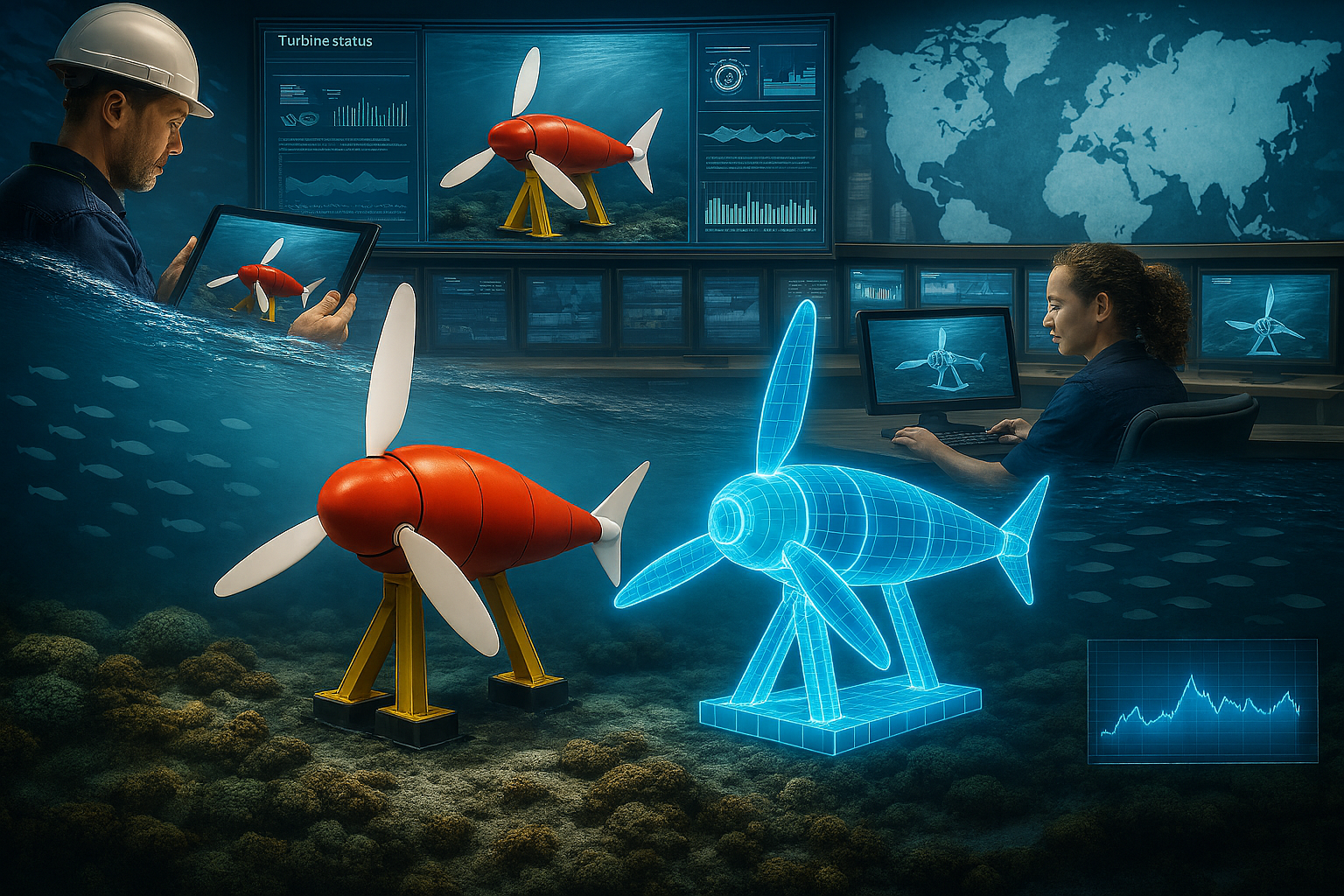
QED Naval is advancing the next phase of tidal energy development by turning real-world operational data into actionable, investor-ready intelligence through its Digital Twin programme.
As part of the EU Interreg-funded Offshore for Sure project, QED Naval and its subsidiary Tocardo BV are building a Digital Twin focused on predictive maintenance, performance optimisation and long-term reliability. The programme draws on years of operational experience from live tidal projects, namely, the Ooseterschelder Tidal Project or OTP, ensuring that future designs and deployments are grounded in proven data rather than theoretical assumptions.
At the centre of this work is Matt Hodges, Tidal Project Analyst at QED Naval, who is responsible for collecting and managing data across the company’s tidal portfolio. This includes Langstone Harbour project and the Subhub-CD tidal platform demonstrator, which operates three T1 tidal turbines. These projects provide critical insights into turbine behaviour, environmental conditions and operational performance.
The Digital Twin is being developed to predict maintenance requirements for key components such as blades, bearings, brakes and generators. By identifying issues earlier and optimising intervention strategies, the system supports improved availability, reduced downtime and lower operational costs.
To accelerate this capability, QED Naval has acquired industry-standard Digital Twin software, including MATLAB, Simulink and Simscape, alongside advanced data acquisition and database toolkits. This enables rapid simulation, deployment and testing of control strategies, as well as the creation of live reporting dashboards. Engineers, customers and stakeholders can monitor performance in near real time or use the system as a simulator to test operational scenarios.
The Digital Twin integrates data from across QED Naval’s engineering disciplines. Hydrodynamic modelling predicts tidal flow conditions, turbine models capture unsteady loading from waves and turbulence, and electrical machine simulations optimise generator performance. Field-scale array modelling assesses turbine interactions, blockage effects and energy yield, providing a high level of confidence in revenue projections.
QED Naval has already deployed the Tocdatacentre at Tocardo BV’s facilities in Vlissingen, the Netherlands, with system upgrades completed. The next phase will connect the Langstone Harbour project to this datacentre, further expanding the Digital Twin’s live data capability. The company is also testing the system using turbines currently stored onshore in Anglesey, North Wales, including two T1 turbines and three T2 turbines.
This data-led approach is a key step in making tidal energy bankable at scale. By combining long-term operational evidence with advanced digital tools, QED Naval is reducing technical risk and strengthening investor confidence in predictable, low-carbon tidal power.